
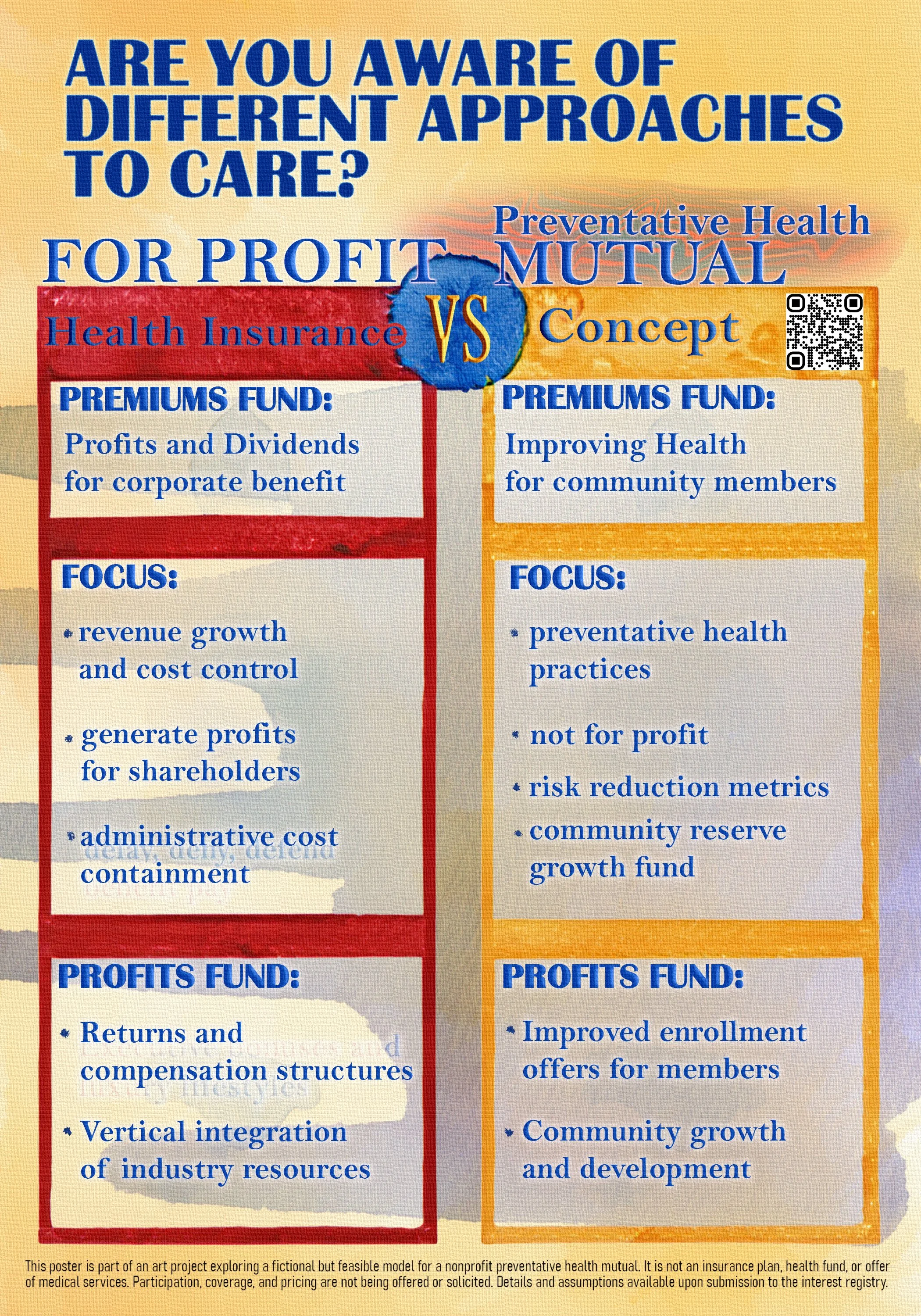
After modeling a fictional but feasible preventative health mutual, I want to slow down and look at what this concept is actually pushing against. For most people in the United States, health insurance is experienced as an opaque obligation. You pay every month, hope you do not need to use it, and brace yourself for confusion when you do. Deductibles, co-pays, surprise bills, denied claims, and out of network penalties are treated as normal. I do not believe they are. This system is not broken by accident. It behaves exactly as a for profit insurance system is designed to behave. In a for profit insurance model, healthcare is not the product. Risk management is. Your monthly premium enters a structure whose primary responsibility is not your health, but the financial performance of the company. Before a single dollar is spent on care, your money pays for administration, executive compensation, marketing, and growth strategies. Claims are paid from what remains, and every claim is, by definition, a cost to be controlled. Preventative care does exist in this model, but not because health is the goal. It exists because preventing some illnesses is cheaper than treating them later. The incentive is not wellness. It is cost containment. This is why interacting with insurance companies so often feels adversarial. It is. The system is financially aligned against generous, early, or abundant care. Your body becomes a variable in a spreadsheet, and your illness becomes a negotiation. A preventative health mutual reorganizes this logic entirely. In a health mutual, there are no shareholders. There is no profit motive. The purpose is not growth, but continuity. The question is not how do we reduce payouts, but how do we remain stable while keeping members well. Monthly contributions go directly toward care, operations run at cost, member prices are locally negotiated, and reserves are held for predictable healthcare use. Risk is not pushed away from the organization onto the individual through deductibles or denials. It is shared across the member group. The structure assumes that people need very basic access to preventative healthcare to keep them well. In a group of more than 1 million people, a preventative health mutual can offer more acute or emergent health coverage. The goal with preventative healthcare is to support wellness among members which naturally keeps healthcare costs more predictable. Most importantly, a preventative health mutual is designed around use. It expects members to access care regularly, to detect issues early, and to maintain health over time. Benefits are intentionally limited in scope and clearly defined, not to restrict care, but to make it understandable and sustainable. This is not catastrophic insurance. It is an investment in habits that support health. If surplus funds exist, they are not extracted. They are reinvested into the community. This can stabilize future costs, expand preventative services, or improve access as participation grows. Health becomes the shared asset, not the expense to be minimized. The difference between these models is not philosophical. It is structural. For profit insurance optimizes for profit under uncertainty. A mutual optimizes for shared stability over time. Neither assumes people behave perfectly. They simply organize incentives differently. This art project is not proposing a perfect solution, nor is it pretending that a preventative health mutual could replace emergency or catastrophic care. What it does offer is a clear demonstration that the system Americans are told is inevitable is actually a choice, a design with values embedded into it. If our healthcare system were aligned with keeping people healthy instead of extracting profit from sickness, it would look very different. This project is an invitation to imagine that difference with clarity, not fantasy. The question is not whether this model is radical. The question is why mutual care feels unimaginable in a country that claims so often to value freedom. If you believe in building a healthcare system based on mutual care and prevention rather than profit, I invite you to join the registry of people interested in participating in a preventative health mutual.
